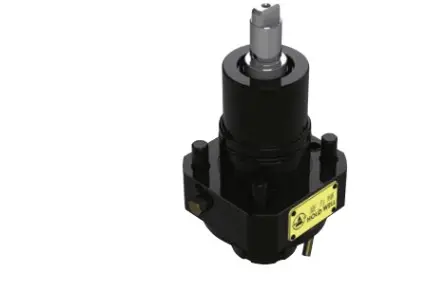
A CNC lathe is capable of more than creating bodies of rotation. Modern production requires performing a maximum of operations per installation. This approach reduces auxiliary time and eliminates relocation errors, directly reducing the cost of the product.
The solution to this problem was the drive equipment. Installing the drive unit in the turret turns the lathe into a machining center. The technology allows milling, drilling and threading at an angle to the axis of rotation, dramatically expanding the capabilities of the equipment.
The direction decides: axial, radial and angular blocks
The choice of block type depends on the location of the surface to be treated and the nature of the operation. Three basic design designs have been adopted:
Axial (axial). The end surfaces of the part are processed. The axis of their tool is parallel to the Z axis of the machine. They drill holes and mill grooves on the end face.
Radial. They work on a cylindrical surface. The tool axis is perpendicular to the axis of rotation of the workpiece. Typical tasks are milling heads and drilling radial holes.
Angular ones. It is a more specialized drive tool for a CNC lathe for machining at an arbitrary angle to the axis of the part. They are indispensable in the manufacture of complex enclosures with inclined surfaces.
The combination of these types covers almost the entire range of off-axis operations in the turning group.
Stiffness or speed: VDI and BMT mounting standards
The reliability and accuracy of fixing the block in the turret is a key factor affecting the purity of the machining and durability of the tool. Two standards dominate the machine tool industry.
The VDI system uses a gear shank. The main advantage is a quick change of equipment. This system is less rigid and is optimal for finishing and semi-finishing operations. The BMT system is a block system, where the holder is attached to the revolver plane with four screws, providing maximum rigidity and vibration resistance. This is the choice for power operations, but it can be more difficult to install the axial and radial drive units correctly. The choice between VDI and BMT is usually determined by the machine design.
Efficiency in metal: key advantages of tooling
The introduction of drive units provides obvious benefits. The reinstallation of the part on the milling machine is excluded, which shortens the production cycle. Accuracy increases, as all processing is performed from a single database.
When choosing equipment, in addition to the type of operation and the standard of fastening, the gear ratio is taken into account.