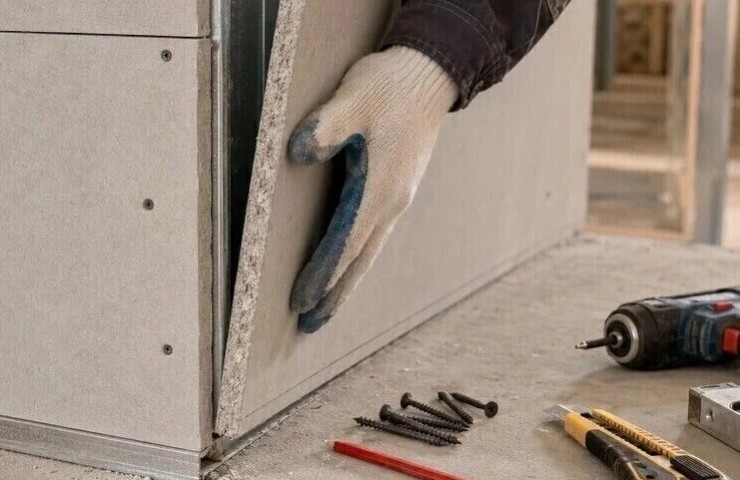
Often, the sheet material deteriorates even before installation: from dampness, improper laying in a warehouse or careless carrying. To get a high-quality result, the hot water pump must be handled carefully at all stages: from unloading to preparation for installation. Let's look at the basic rules for handling the material.
Storage conditions
The sheets are stored in a dry room on a flat surface, on wooden linings with the same pitch so that they do not deform. The stack is covered from dust and moisture, and direct contact with the floor and walls is excluded.
Storage rules
- Lay the sheets horizontally, not obliquely or on an edge.;
- Limit the height of the stack based on the manufacturer's recommendations.;
- Avoid exposure to water and condensation;
- Protect the edges from bumps and chips;
- Before installation, keep the material indoors to adapt to humidity.
Carrying and loading
The material is noticeably heavier than ordinary drywall, so it is carried together, holding the sheet on the edge. Special trolleys and lifting equipment are used for lifting to the floor, and in the back they are transported only in a horizontal position with reliable fixation.
Cutting tools
For cutting, an electric jigsaw, a circular saw or a special knife is used, followed by a chisel along the incision. After cutting, the edge is cleaned with a plane or a sandpaper, if necessary, chamfering the filler.
Security measures
When cutting, dust forms, so protective glasses and a respirator are needed, and it is better to equip the workplace with an extractor hood or a vacuum cleaner. Sharp edges and heavy sheets require gloves and care when working at height.
Preparing the sheets for installation
- Unpack and inspect the sheets for damage;
- Withstand the material in the work area;
- Cut the sheets according to the scheme, minimizing waste;
- Process the edges and chamfer;
- Prepare fasteners and tools.
Result
Proper storage, careful transportation and competent cutting preserve the quality of the material and save time during installation. Following these simple rules protects the sheets from damage and avoids unnecessary costs.